

Otosclerosis
Otosclerosis is an inherited condition caused by the accumulation of abnormal bone growth onto the tiny stirrup-shaped bone, the stapes. The stapes is the third of the hearing bones, and its motion on the footplate of the inner ear moves the fluid within the inner ear and allows us to hear. The over-growth of bone associated with otosclerosis may cause the stapes bone to become fixed, thus restricting its motion. This process may affect one or both ears. It usually begins in the late teens or early twenties, and it is slowly progressive. When otosclerosis fixes the stapes it causes a “conductive” type of hearing loss due to poor motion of the hearing bones. This is a correctable type of hearing loss. Otosclerosis can also cause a “nerve” type of hearing loss due to the release of chemicals into the inner ear fluids. This may increase ringing in the ear known as tinnitus. This type of hearing loss is not correctable. The portion of your hearing loss that is conductive and nerve can be determined by detailed hearing tests.
How does a “normal” ear function?
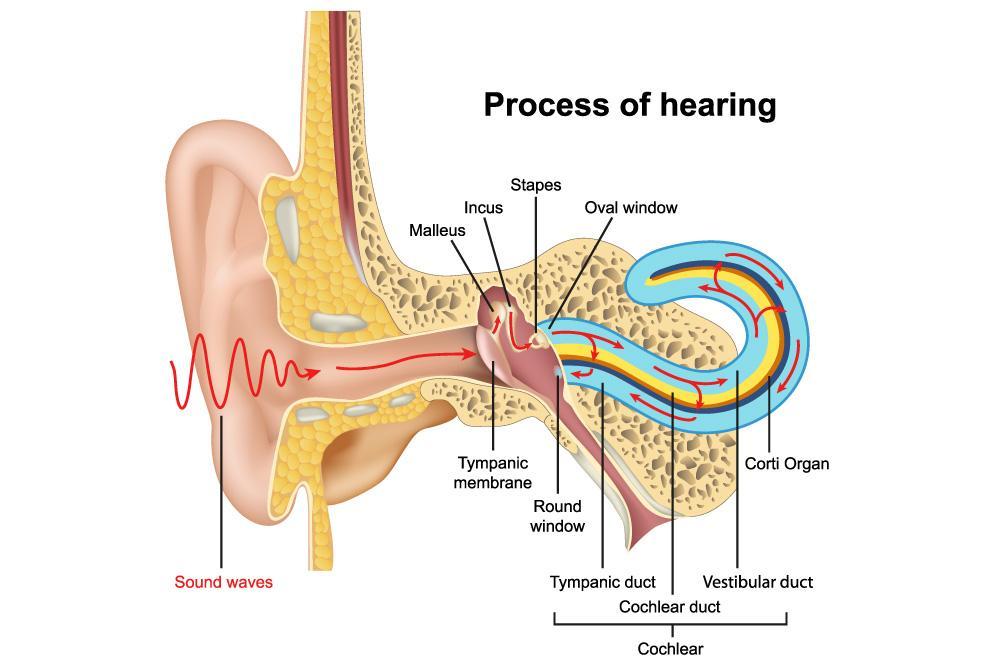
The ear is divided into three parts; the external ear, the middle ear, and the inner ear. The external ear collects sound, the middle ear mechanism transforms the sound and the inner ear receives and transmits the sound.
Sound vibrations enter the ear canal and cause the eardrum to vibrate. Movements of the eardrum are transmitted across the middle ear to the inner ear fluids by three small ear bones. These middle ear bones (hammer or malleus, anvil or incus and stirrup or stapes) act as a transformer changing sound vibrations in air into fluid waves in the inner ear. The fluid waves stimulate delicate nerve endings in the hearing canals. Electrical impulses are transmitted on the nerve to the brain where they are interpreted as understandable sound.

What are the types of hearing impairment?
The external ear and the middle ear conduct sound; the inner ear receives it. If there is some difficulty in the external or middle ear, a conductive hearing impairment occurs. If the trouble lies in the inner ear, a sensorineural or nerve hearing impairment is the result. When there is difficulty in both the middle and the inner ear a mixed or combined impairment exists. Mixed impairments are common in otosclerosis.

Hearing Impairment from Otosclerosis
Stapedial Otosclerosis
Usually otosclerosis spreads to the stapes or stirrup bone, the final link in the middle ear transformer chain. The stapes rests in the small groove, the oval window, in intimate contact with the inner ear fluids. Anything that interferes with its motion results in a conductive hearing impairment. This type of impairment is called stapedial otosclerosis and is usually correctable by surgery. The amount of hearing loss due to involvement of the stapes and the degree of nerve impairment present can be determined only by audiometric examination (hearing tests).
Cochlear Otosclerosis
When otosclerosis spreads to the inner ear a sensorineural hearing impairment may result due to interference with the nerve function. This nerve impairment is called cochlear otosclerosis and once it develops it may be permanent. On occasion the otosclerosis may spread to the balance canals and may cause episodes of unsteadiness.
Medical Treatment
There are no medicines that can correct or prevent the conductive type hearing loss of otosclerosis. However, treatment with a fluoride medication may be used in the patient who is developing nerve-type hearing loss related to otosclerosis. Fluoride in moderate doses has been shown to inactivate the toxic chemicals of the abnormal otosclerotic bone that are toxic to the hearing nerves. It does not recover any nerve loss or improve any tinnitus that has already occurred but can prevent its worsening. However, it must be taken in moderate doses for at least one to two years until the progression of nerve loss has stopped, and thereafter in smaller doses indefinitely. This medicine should not be used in any individuals of child-bearing age and has several other potential risks.
A hearing aid can be effective in treating the hearing loss related to otosclerosis in the majority of patients whether it is nerve or conductive. Whether or not a hearing aid is the best option for you is an individual decision between you and your doctor.
Surgical Treatment: Stapedectomy
The conductive type of hearing loss caused by otosclerosis is correctable by a highly successful surgery known as a stapedectomy, performed through the ear canal under local or general anesthesia. Stapedectomy is successful in 95% of patients, with most experiencing significant hearing improvement within six weeks of surgery.
For a full explanation of the procedure, recovery, and potential risks, including patient videos, see our detailed guide to Otosclerosis Surgical Treatment.